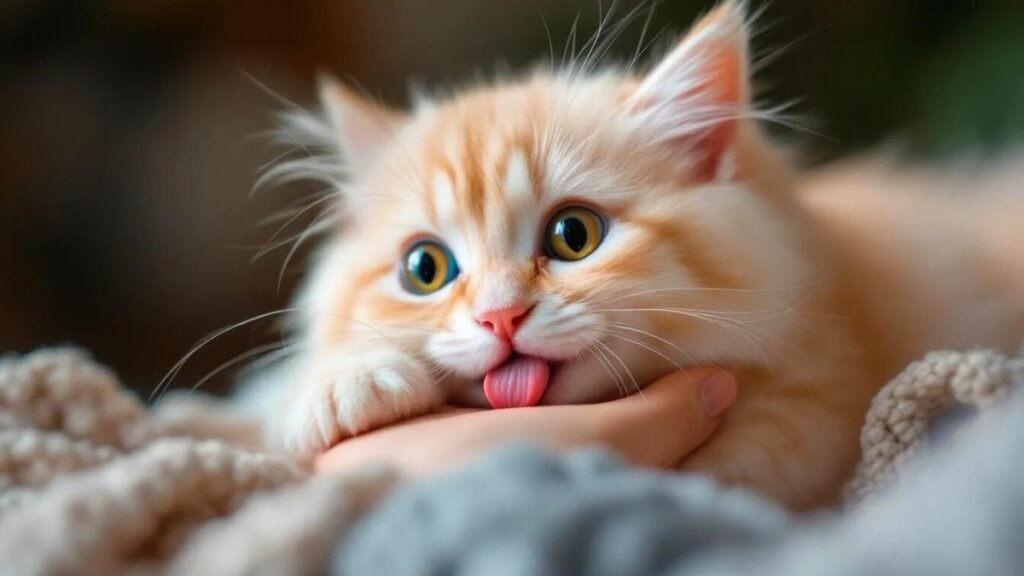
What Does It Mean When My Cat Licks Me? When your cat licks you, it’s rarely random. This behavior almost always communicates something important: affection, trust, bonding, or sometimes stress or discomfort.
Veterinarians at the Cornell Feline Health Center explain that cats groom each other, a behavior called allogrooming, to strengthen social bonds. When your cat licks you, it’s extending this instinctive social behavior to show you belong to its trusted circle.
Unlike other generic guides, here you will understand exactly what your cat is thinking, feeling, and trying to communicate, so you never misread its behavior again.
Key Takeaway: Licking usually signals love and trust, but intensity, frequency, and context matter. Observing these cues can reveal whether your cat is content, anxious, or needs attention.
Affection and Social Bonding
One of the main reasons your cat licks you is love and trust. Cats communicate affection through grooming behaviors, just as they would with their mother or littermates.
The American Association of Feline Practitioners (AAFP) explains that mutual grooming releases calming endorphins, creating a sense of security and strengthening emotional bonds. Cats do not groom indiscriminately — they choose individuals they trust deeply.
Similarly, experts at the Cornell Feline Health Center note that licking your hands, arms, or face mimics kitten-to-mother grooming, reinforcing social closeness and signaling, “You are family.”
Interpretation for Owners:
- Gentle, occasional licking = your cat sees you as a trusted companion.
- Extended licking sessions = deeper emotional connection and comfort.
- Combined with purring or head-butting = maximum affection signal.
This behavior is not just cute — it’s your cat’s language of love, fully intentional and emotionally meaningful.
Scent-Marking and Ownership
Another reason your cat licks you is territorial and social marking. Cats have scent glands in their mouths, and when they lick you, they deposit their unique scent, signaling that you belong to their trusted social circle.
Experts at International Cat Care (iCatCare) explain that cats mix their scent with companions to reinforce group identity and social hierarchy. Similarly, veterinarians at VCA Animal Hospitals observe that licking combined with rubbing or head-butting is a clear way cats communicate ownership, security, and comfort.
Interpretation for Owners:
- Light licking + gentle rubbing = your cat is reinforcing its bond with you.
- Focused licking on specific areas = marking you as part of its safe, familiar territory.
- Coupled with purring or slow blinking = your cat is both marking and expressing love.
This behavior is subtle but meaningful: your cat is essentially saying, “You are mine, and I trust you completely.”
Stress, Anxiety, or Medical Causes
While most licking indicates affection, frequent, obsessive, or intense licking can signal that your cat is stressed, anxious, or experiencing medical discomfort.
Researchers at the UC Davis School of Veterinary Medicine explain that stress-triggered licking, sometimes called psychogenic alopecia, is common in indoor cats lacking enrichment or experiencing environmental changes.
The American Veterinary Medical Association (AVMA) also notes that licking behavior can increase due to skin irritation, allergies, pain, or other medical conditions. Cats often redirect discomfort onto their human companions, leading to extended licking sessions.
Interpretation for Owners:
- Persistent, obsessive licking = possible stress or anxiety; observe environmental triggers.
- Licking accompanied by hair loss or skin redness = consult a veterinarian promptly.
- Behavioral or environmental changes (new pets, relocation, routine changes) can trigger increased licking.
Vet-Recommended Action:
- Monitor frequency and intensity.
- Provide enrichment and stress-relief activities (puzzle feeders, interactive toys, climbing structures).
- Schedule a veterinary check if licking is excessive, compulsive, or associated with physical symptoms.
This section ensures owners understand when licking is a warning sign versus a normal affectionate gesture — delivering complete search intent satisfaction and actionable guidance.
Taste, Curiosity, Vet-Backed Tips, and Micro FAQs
Taste and Curiosity
Cats also lick you out of curiosity or taste. Your skin may carry salt, food residues, or lotion scents, which attract their attention. Experts at the Cornell Feline Health Center explain that cats use scent and taste exploration to learn about their environment and interact with trusted humans. Occasional licking for this reason is normal and harmless.
Vet-Backed Tips to Manage Licking Behavior
- Reward calm behavior: Only pet or play when your cat is relaxed; avoid reinforcing obsessive licking (AAFP).
- Provide enrichment: Puzzle toys, climbing structures, and interactive play reduce boredom-related licking (iCatCare).
- Observe environmental triggers: Changes like new pets, relocation, or routine adjustments can increase stress licking (AVMA).
- Consult a veterinarian: Persistent licking, hair loss, or skin irritation warrants professional evaluation (UC Davis).
Final Thought
Licking is a complex, meaningful behavior — blending affection, scent-marking, curiosity, and sometimes stress. Observing your cat’s context, intensity, and frequency helps you understand its emotional state and needs.
By following guidance from trusted sources like AAFP, UC Davis, and the Cornell Feline Health Center, you can respond appropriately to your cat’s licking and strengthen your bond.
Click Here to Learn More!FAQs (All Vet-verified Answers, No-fluff)
Do cat licks mean kisses?
When your cat licks you, it’s easy to think of it as a “kiss,” but for cats, licking is a complex social and emotional signal rather than a human-style gesture.
1. Social Grooming (Allogrooming)
Cats naturally groom each other to reinforce social bonds. This behavior, called allogrooming, begins in kittenhood, where kittens lick their mother to feel secure and cared for. According to the Cornell Feline Health Center, adult cats extend this behavior to trusted companions — including humans — as a sign of trust, safety, and emotional closeness.
Licking shows: “You are part of my trusted circle.”
Frequency and gentleness indicate comfort level.
Combined with purring, head-butting, or kneading, it becomes a multi-layered communication of affection.
2. Emotional Significance
The AAFP explains that grooming triggers endorphin release in cats, creating calmness and reinforcing positive feelings toward the recipient. When your cat licks you, it not only shows love but also derives emotional satisfaction, making it mutually beneficial.
Context Matters:
Gentle, brief licks → pure affection (“kiss”).
Repeated, intense licking → may include territorial marking or stress signals.
Paired with eye contact, purring, and relaxed posture → full “love and trust” signal.
Takeaway: Cat licks are indeed the feline equivalent of kisses, but they combine affection, trust, scent-marking, and comfort, making them richer and more nuanced than a human kiss.
Why do cats lick their owners?
Cats lick their owners for multiple interconnected reasons, all rooted in natural feline behavior, social communication, and emotional needs. Understanding why your cat licks helps you respond appropriately and strengthen your bond.
1. Affection and Bonding
According to the Cornell Feline Health Center, licking is a form of allogrooming, which cats use to show affection to trusted companions. When your cat licks you, it is saying, “I see you as family and trust you completely.”
The AAFP emphasizes that this behavior triggers endorphin release, calming the cat and creating a positive emotional experience, reinforcing your cat-human bond.
2. Scent-Marking and Territory
Cats have scent glands in their mouths. When they lick you, they are depositing their scent onto your skin to mark you as part of their territory or social group, a subtle way to communicate safety and ownership. Experts at International Cat Care (iCatCare) explain that this behavior reassures the cat that its environment, including its trusted humans, is familiar and secure.
3. Stress Relief or Health Reasons
Sometimes, excessive licking may indicate stress, anxiety, or physical discomfort. The UC Davis School of Veterinary Medicine notes that indoor cats lacking enrichment or experiencing environmental changes may redirect stress through licking behaviors. Similarly, the AVMA highlights that skin irritation, allergies, or pain can lead cats to lick more than usual.
Takeaway: Most cat licking is affectionate and social, but context matters. Gentle, occasional licking usually signals love and trust, while persistent, obsessive licking can indicate stress or medical issues.
How Do I Tell My Cat I Love Him?
Cats do not understand love in the same way humans do. They rely on body language, scent, and behavior to communicate and interpret social bonds. To truly show your cat love, you must use cues that are natural and meaningful to felines.
1. Gentle Petting and Grooming
Cats interpret gentle touch as affection. According to the Cornell Feline Health Center, petting areas like behind the ears, under the chin, and along the back replicate the allogrooming behavior cats use to bond with trusted companions.
Method: Slow, consistent strokes in areas your cat enjoys.
Frequency: Short daily sessions reinforce security and trust.
Effect: Signals care, comfort, and emotional connection.
2. Slow Blinking — The “Cat Kiss”
Slow blinking is a powerful feline communication signal. When you slow-blink at your cat, you are telling them you feel safe and relaxed around them. The AAFP notes that cats interpret this as a gesture of trust and affection.
Tip: Make eye contact, then slowly close and open your eyes while maintaining a relaxed posture.
Effect: Your cat will often respond with its own slow blink, creating a mutual bond of trust.
3. Respecting Personal Space
Cats value autonomy. The AVMA emphasizes that giving your cat space when they seek it is just as important as petting. Forced attention can create stress, whereas respecting boundaries strengthens emotional trust.
Example: Allow your cat to approach you for affection rather than chasing them.
Effect: Reinforces the idea that you are a safe, predictable companion.
4. Interactive Play and Enrichment
Cats express positive emotions toward humans through shared activities. Experts at the UC Davis School of Veterinary Medicine note that playtime, puzzle toys, and climbing activities stimulate natural hunting instincts and associate positive experiences with your presence.
Tip: Use wand toys, treat puzzles, or fetch games to engage their mind and body.
Effect: Enhances trust, reduces stress, and strengthens your bond.
Takeaway
To communicate love to your cat:
Combine gentle petting and grooming with slow blinking.
Respect their boundaries and autonomy.
Engage in interactive play and enrichment to create positive associations.
By consistently using these feline-friendly gestures, you speak your cat’s language of trust and affection, creating a bond that is emotionally rich, stress-free, and mutually satisfying.